Please enable javascript in your browser to view this site!

 RESEARCH IS PART OF OUR ORIGIN.

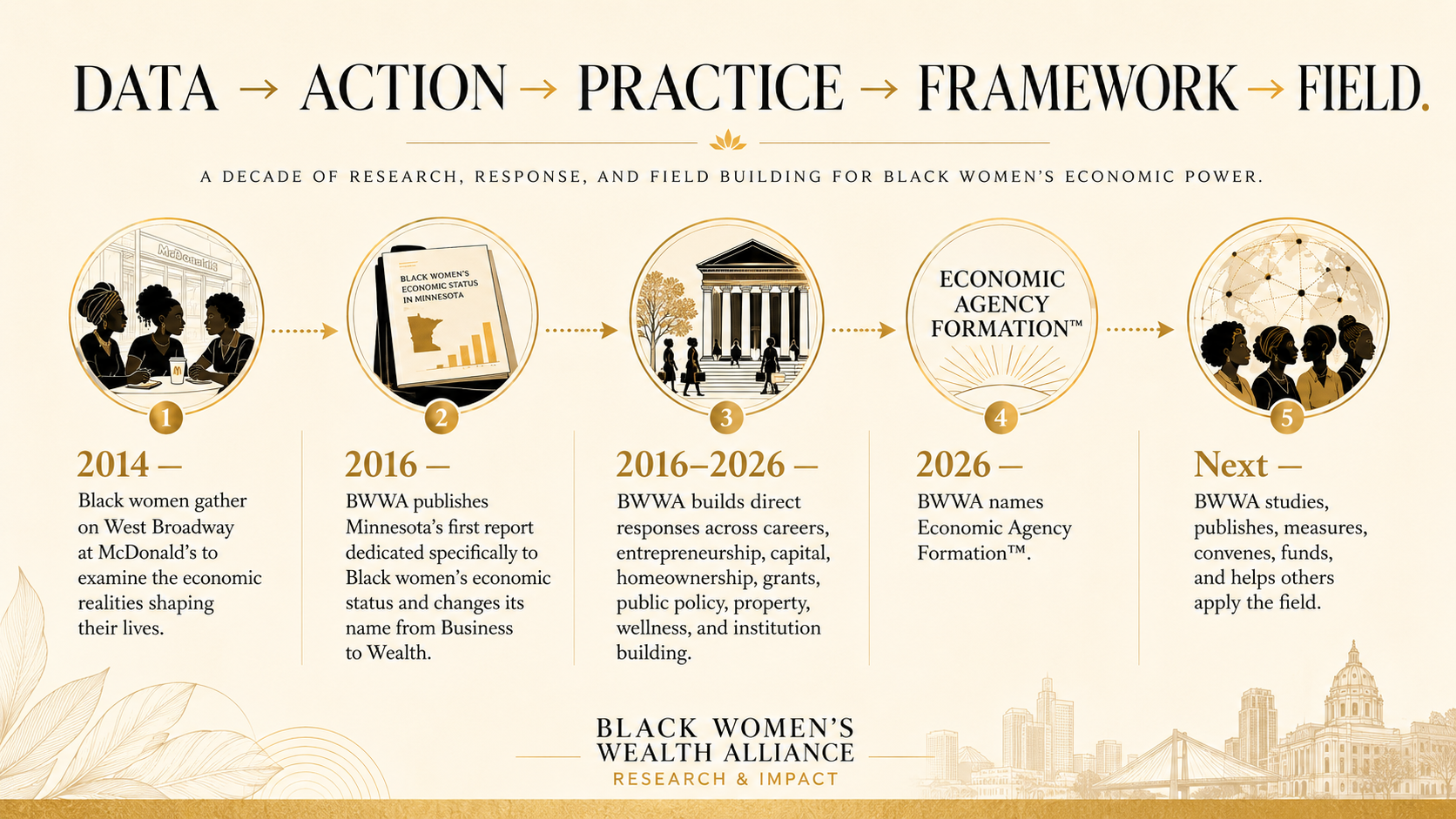
In 2016, after finding no Minnesota report dedicated specifically to the economic status of Black women, BWWA published Minnesota’s first: The State of Black Women’s Economics in Minnesota: A Starting Place. The report challenged aggregated data, centered the distinct economic realities of Black women, and helped move the organization from a business-centered identity toward wealth, ownership, and economic agency.
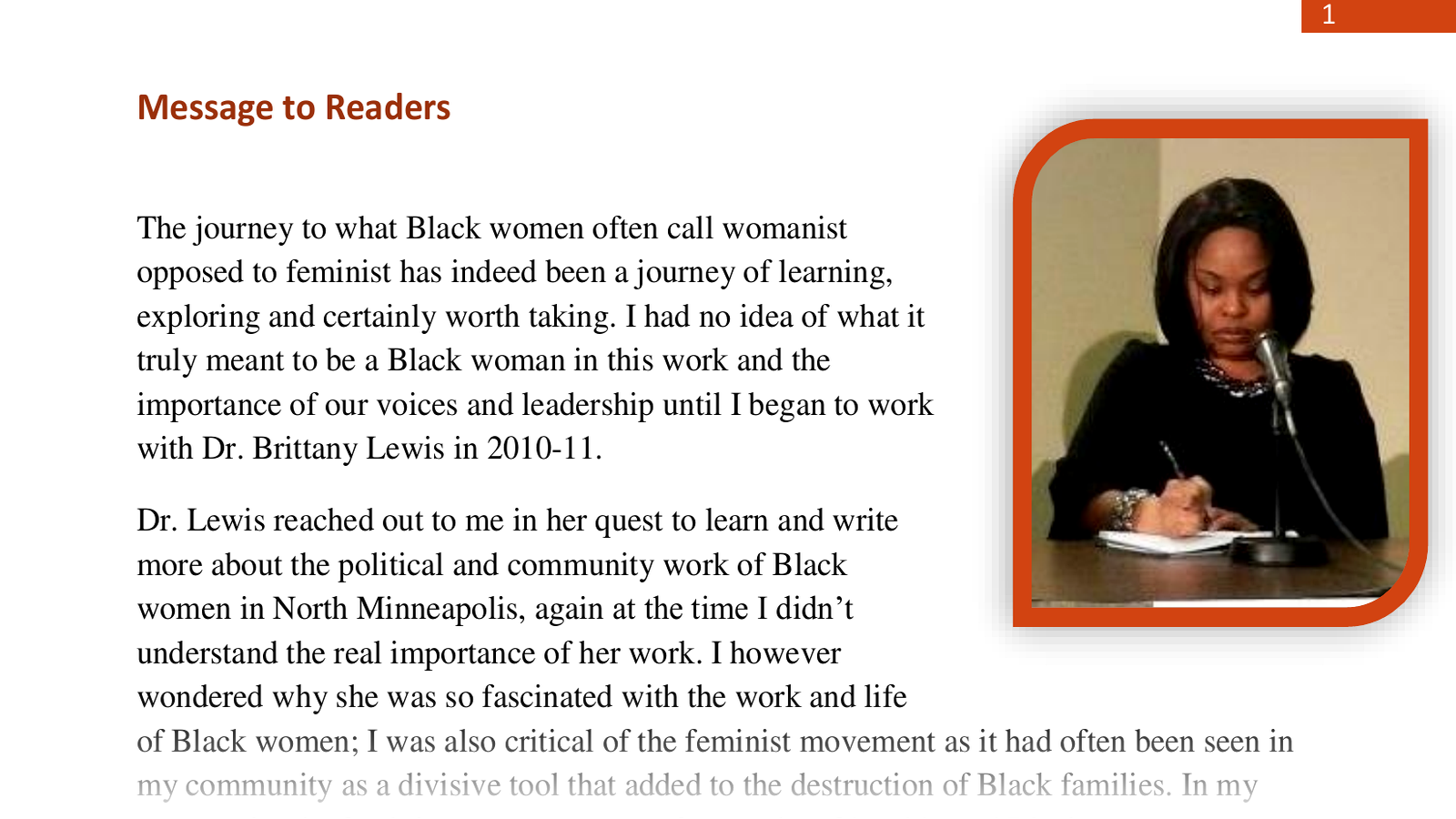


“Founder’s message page from BWWA’s 2016 report, featuring a portrait beside the opening letter.”
 

MINNESOTA’S FIRST REPORT ON THE ECONOMIC STATUS OF BLACK WOMEN.

Published in March 2016 by Black Women’s Wealth Alliance—formerly the Black Women’s Business Alliance—and sponsored by the University of Minnesota’s Center for Urban and Regional Affairs, A Starting Place examined unemployment, occupational concentration, entrepreneurship, business lending, and barriers to economic independence. Brittany M. Lewis, PhD, served as principal researcher.

The report was intentionally introductory. It called for continued data disaggregation, community participation, policy development, and a broader research agenda focused on Black women and girls.


THE RESEARCH CHANGED THE ORGANIZATION.

BWWA began as the Black Women’s Business Alliance. The 2016 research made clear that business ownership was one economic tool within a much larger question involving income, assets, capital, homeownership, security, ownership, and community prosperity. The organization became the Black Women’s Wealth Alliance to reflect that broader mission.


BEFORE WE NAMED IT.

Before We Named It is not the beginning of BWWA’s research. It is the retrospective bridge between A Starting Place and Economic Agency Formation™. BWWA will examine twelve years of applications, programs, grants, capital support, coaching, referrals, participant records, outcomes, and stories to understand how economic agency appeared in practice before the framework had a formal name.

The retrospective will distinguish what BWWA records document, what alumni report, what can be interpreted retrospectively through the current EAF framework, and what remains unknown.


FROM ECONOMIC CONDITIONS TO ECONOMIC AGENCY FORMATION.

The updated study will carry forward the original research mandate in two connected parts. Part One will examine present economic conditions—including employment, income, business ownership, housing, assets, debt, protection, networks, barriers, and future goals. Part Two will examine Economic Agency Formation™ across identity and direction, knowledge and capability, relationships and networks, stewardship and ownership, and institution and community connection.

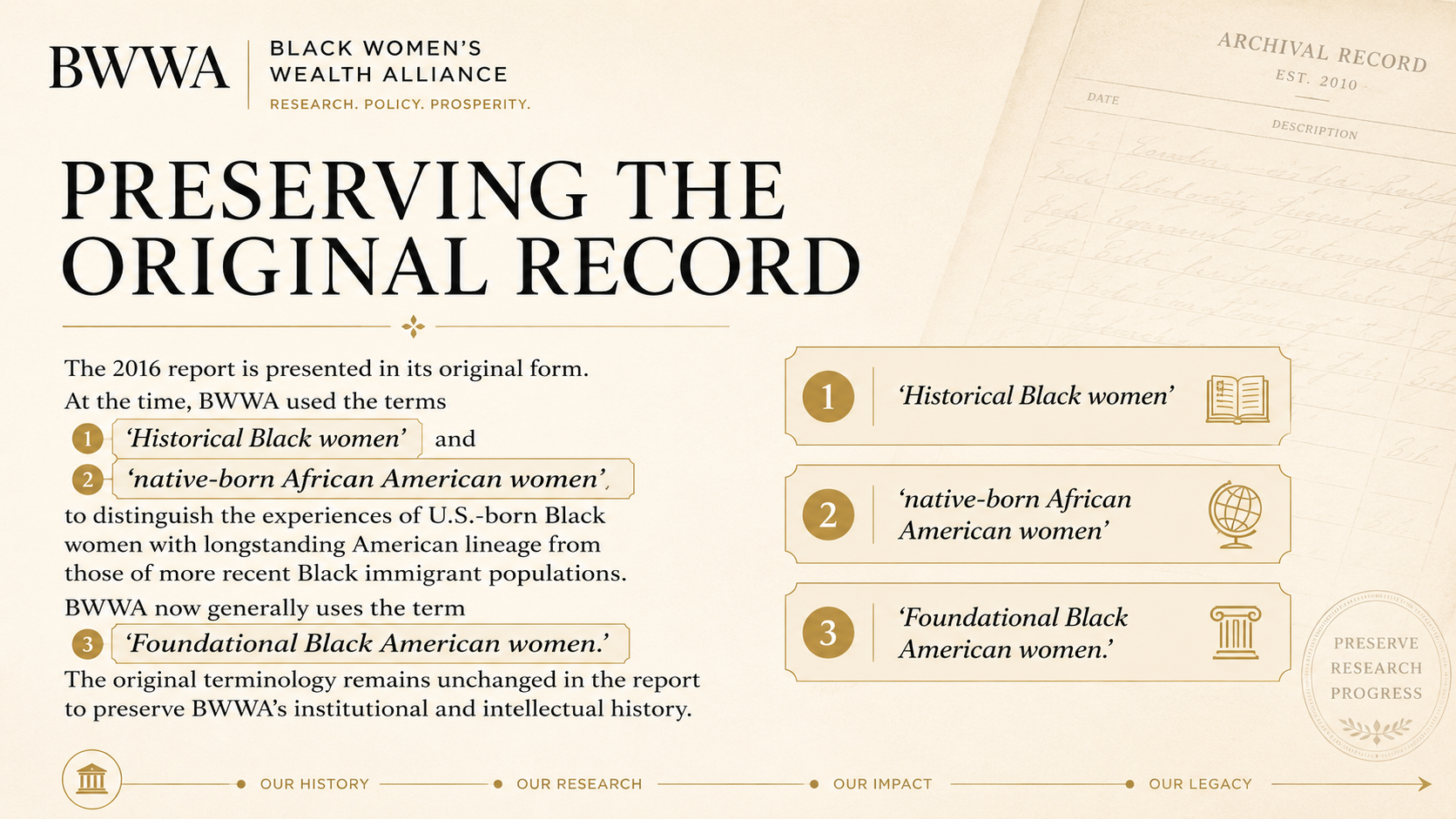
The study will center Foundational Black American women while welcoming responses from Black women across identities so differences can be understood rather than hidden inside aggregated data.


Alumni Economic Agency Pulse

A brief annual alumni update will help BWWA understand where former participants are now and how careers, businesses, assets, ownership, networks, leadership, family impact, and community contribution have evolved over time. Administrative records will be paired with voluntary alumni updates rather than treated as a substitute for alumni voice.


HOW BWWA WILL REPORT.

BWWA will distinguish historical public data, administrative records, participant-reported outcomes, retrospective interpretation, current survey findings, external research, and verified case studies. Historical records will be mapped to the current EAF framework as an interpretive lens—not presented as though BWWA measured Economic Agency Formation™ before the framework existed. Personal stories and quotations will only be published with permission, and aggregate findings will be reported with appropriate privacy protections.


FREE DOES NOT MEAN PUBLIC DOMAIN.

BWWA’s public tools are offered for personal, noncommercial use. Organizational, facilitation, training, reproduction, resale, or curriculum use requires written permission or an appropriate license.